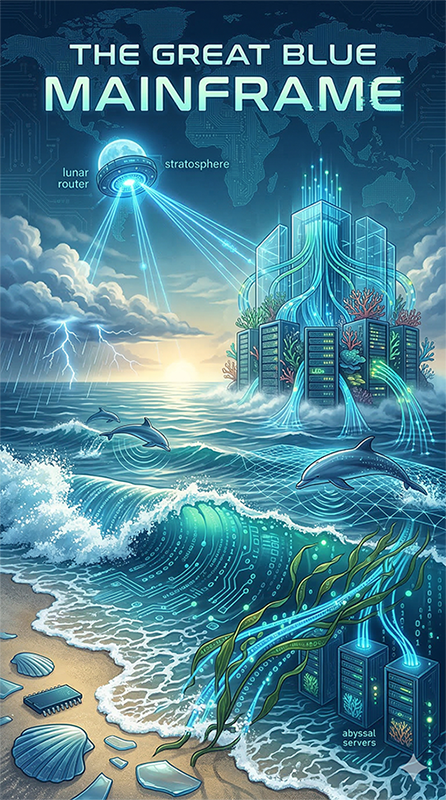
The great blue mainframe powers up at dawn,
booting through the mist of a salt-heavy sky,
where the horizon acts as the ultimate firewall
between the known shore and the deep unknown.
Packets of water begin their long transmission.
A quiet hum of tidal bandwidth rises,
pulsing from the lunar router in the stratosphere,
syncing the rhythm of the pelagic heartbeat.
There is no latency in this liquid architecture,
only the unbroken flow of a global stream.
Whitecaps form like bursts of sudden data,
encrypted in the foam of a thousand crashing crests.
They carry the sunlight down optic-nerve kelp,
routing warmth through the cold, abyssal servers
that sleep in the midnight zone below.
Watch the surf as it renders on the shoreline,
pixel by pixel, grain of sand by grain of sand.
It uploads a fresh canvas every fourteen hours,
clearing the cache of footprints and debris,
leaving a pristine interface for the morning.
Each wave is a message sent across the proxy,
bouncing off the continental shelves.
We stand on the beach like terminal nodes,
receiving the vast, uncompressed files of the sea,
breathing in the sweet, ozone-rich code.
Down in the coral racks, the reef is flashing,
bioluminescent LEDs blinking green and gold.
They signal the health of the mother ocean’s core,
a decentralized network of anemone and sponge,
processing the current with delicate precision.
There are storms, yes, denial-of-service gales,
when the wind floods the system with rogue inputs.
The surface thrashes in a chaotic overload,
black waters churning in a furious spin,
testing the resilience of the ancient cables.
But the deep web of the Mariana Trench holds fast.
The tectonic plates maintain their server racks,
grounding the tempest in cold, geologic truth.
When the atmospheric glitch finally resolves,
the connection stabilizes, wider and clearer.
Look how the dolphins navigate the local area,
echolocation pinging like a steady sonar pulse,
checking the latency of the local mesh network.
They leap through the interface, joyous and fast,
proof that the system is alive and singing.
Every drop of rain is a system update,
downloaded from the heavy, bloated clouds.
It patches the salinity, refreshes the volume,
mingling the freshwater variables with the brine,
ensuring the code remains dynamic and fluid.
The shoreline is an open-source sanctuary.
Here, the ocean shares its sprawling database,
washing up shells like fragmented memory chips,
smooth glass like polished, retired hardware,
gifts from the vast, underwater silicon plains.
Even the riptides have a hidden logic,
background processes sweeping the shallows clean.
They redirect the flow of stray electrons,
pulling the excess energy back into the fold,
recycling the momentum for the next great swell.
We are learning to read the surface ripples,
deciphering the syntax of the changing tides.
We map the gyres like global routing tables,
tracing the Gulf Stream’s high-speed fiberline,
marveling at the sheer capacity of the blue.
There is a promise in the ocean’s steady ping,
a relentless, driving force of connection.
It links the frozen poles to the boiling tropics,
a seamless intranet spanning the entire globe,
ignoring the artificial borders drawn on maps.
At night, the silver moonbeams cast a wireless glow,
illuminating the bandwidth of the cresting swells.
The stars reflect like nodes on a sprawling graph,
mirroring the heavens in a dark, aquatic screen,
a dual-monitor display of the universe.
When you plunge your hands into the chilling surf,
you are plugging directly into the mainframe.
You can feel the vibration of a billion gallons,
the synchronized processing of a trillion lives,
all working together in an open protocol.
The architecture is built to last forever.
It auto-corrects the damage and the wear.
Through evaporation and the steady fall of rain,
it reboots the cycle, flawless and renewed,
a perpetual motion engine of pure potential.
Listen to the crash against the coastal rocks—
it is the sound of data breaking into life.
It is the voice of a system too vast to fail,
whispering a coded promise of tomorrow,
where the water is clear and the bandwidth is free.
This is the original, unhackable internet,
woven from hydrogen, oxygen, and salt.
It connects the solitary islands of our hearts,
bridging the lonely distances between the continents,
washing away the static of our daily fears.
So let the great waves crash and let them roll,
infinite loops of beauty and of grace.
The ocean's server hums its hopeful song,
a network bound by gravity and light,
transmitting life across the waking world.