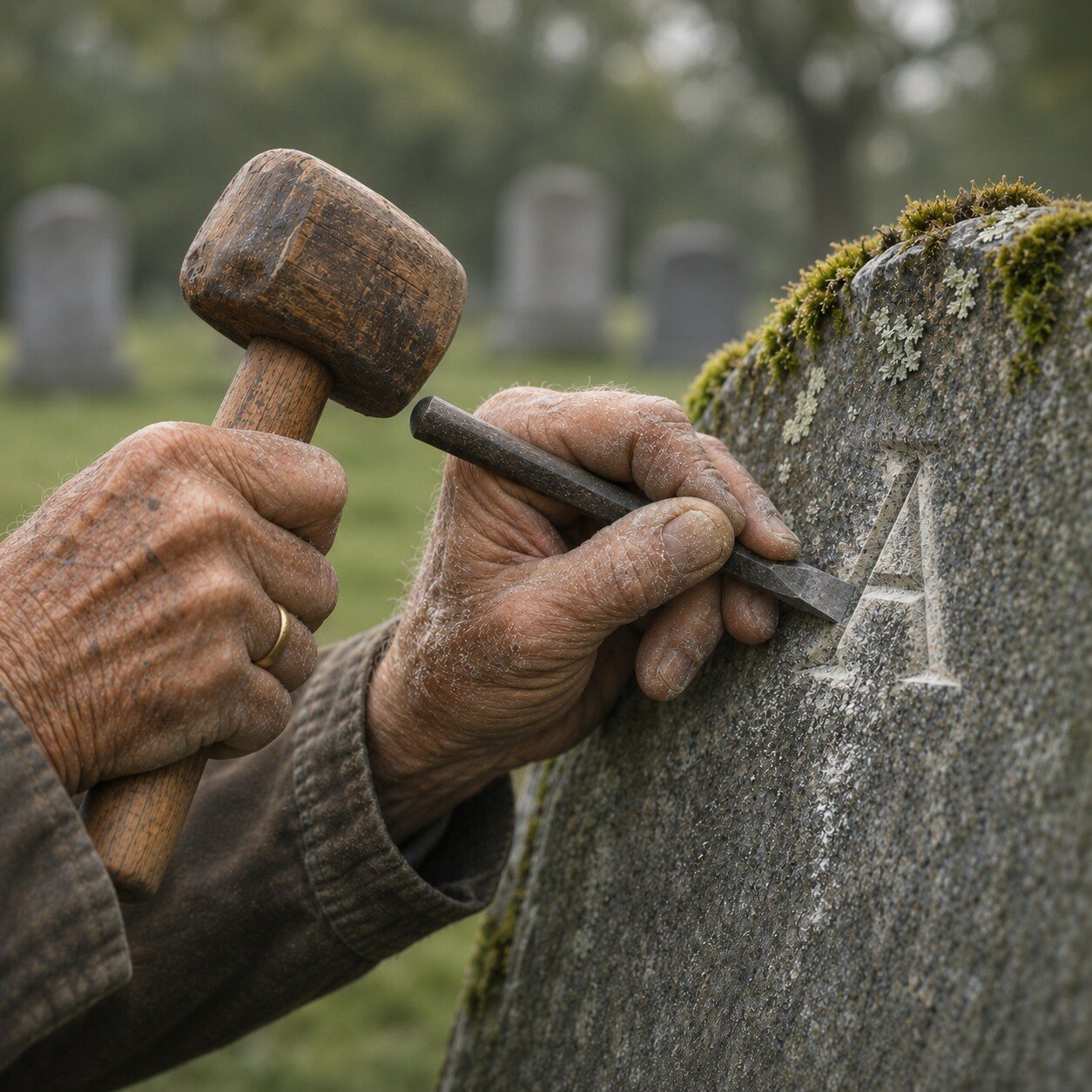
I spend my days returning letters to the dead.
Rain begins with the softer ones:
C, G, the open mouth of U.
Winter takes the dates next.
A century can disappear
from one corner of a stone.
I kneel in the grass with brush and chisel,
clear moss from a family stone,
open the closed loop of an R,
deepen a date until the daughter beside me
can read it without bending.
By five, my hands are grey with everyone.
At home, I pin a card above my heart:
DAVID
YOUR HUSBAND
FORTY-TWO YEARS
My wife reads it over breakfast.
“No,” she says.
“My husband was young.”
“He was,” I tell her.
“Once.”
Some mornings she asks what he was like.
I say he burned the onions,
slept through thunderstorms,
kept every screw in a coffee tin,
and learned too late
how to say he was sorry.
She listens carefully.
“Was he kind?”
“Not always.”
“Did he love me?”
“Yes,” I say.
“But he made you wait for proof.”
She nods.
“That sounds like him.”
Other mornings, she gives him
a life we never lived:
a violin, a red horse,
an orchard somewhere in Spain.
I do not correct her.
She always gives him my hands.
Yesterday, she touched my face,
her thumb resting
in the line beside my mouth.
“He would have liked you,” she said.
I nearly corrected her.
For one selfish moment,
I wanted her to remember me.
Instead I said,
“I think so.”
This morning, I return
to the same family stone.
One letter is still too shallow.
I place the chisel in its groove
and strike deeper than I need to—
not to defeat the rain,
only to give it
a little more work
to do.