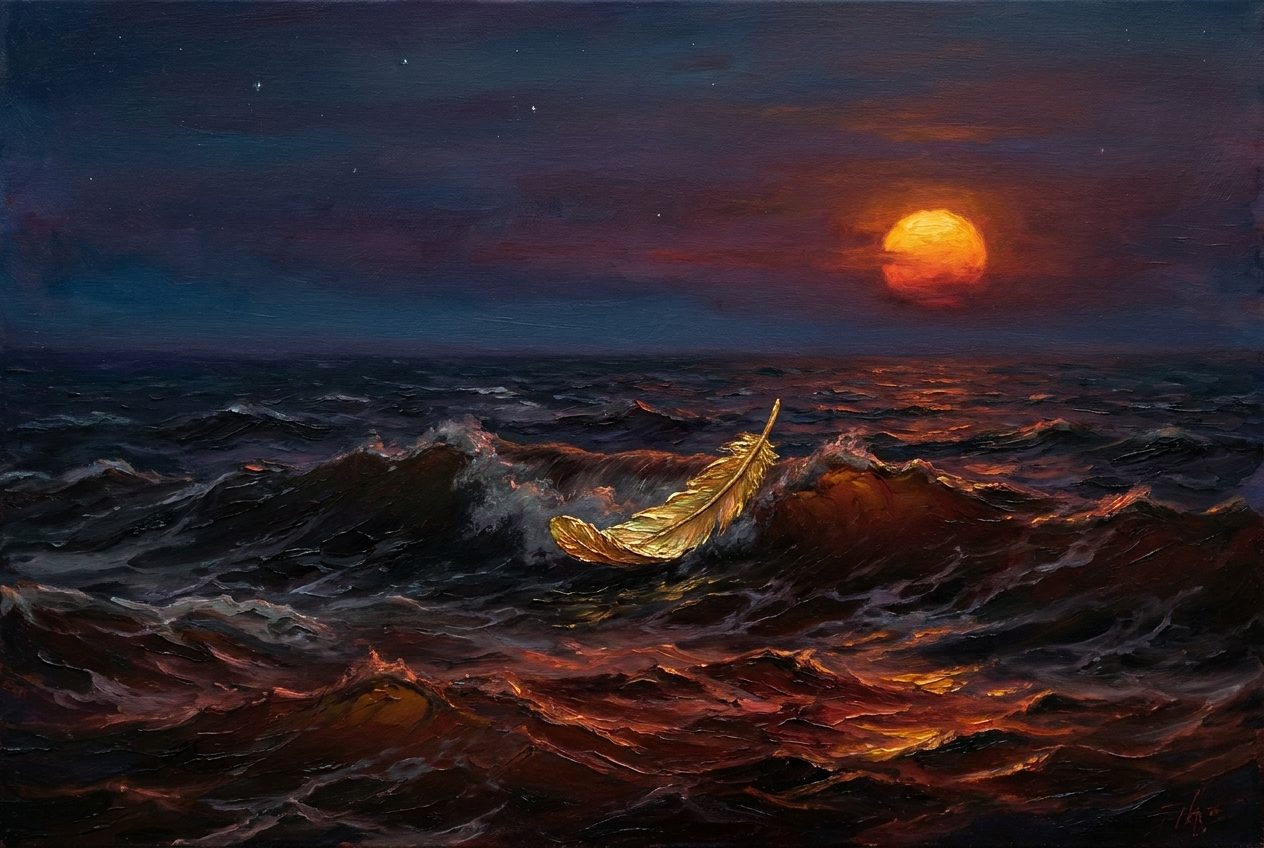
Icarus

Human Written by Elizabeth Ulinfun ·
Image for Icarus

ICARUS

You have fallen for an Icarus
One who is obsessed with his legacy
He tends to forget he is not his legacy
He is obsessed with his ambition
His goals and his motives rival none

You have fallen for an Icarus
He will fly as much as he can
He will touch the skies
You have married an Icarus
Obsessed with his image
Infatuated with his might
Charismatic and golden

You have married an Icarus
Such is your fate
It is what you wanted, no?
To see the sun
Touch the moon
You shall want for nothing
Your heart shall be filled with your darkest desires
Your belly filled with golden pastries
The bells sing at the union

You have fallen for an Icarus
Your life is no longer your own
Your tears are salty
Like oceans and seas that call forth his name
Your legacy shall be held in the stars
Your name scratched into stone
You have married an Icarus
The one who thought himself a god
Untouchable to all things

Icarus, have you flown too close to the sun?
Does your beloved know where you are?
Have you seen the beauty of its glow?
Have you come to desire it so?
Icarus, Icarus, Icarus
Does the moon, sun, or beloved call your name?
Your greed has no mate
Ambition no soul
Your chest no heart
Riches and gold have you all

Little boy Icarus
You have flown once again
Forgotten lessons once taught
Thralled by the sun's heat
Its glow calls to you
Icarus, it sings
Will the boy listen?
Of course you shall
You cannot resist
You fly with your wing
Your ambition and your legacy
You fly until you feel its heat against your skin
Until you feel your sweat caress your skin

You have fallen for an Icarus
One who thought himself a god
One who the stars make jest of
One who fell and only the ocean knows his name

Icarus

How did this poem make you feel?

Share:

Community Score

—
out of 10

0 votes

Log in to vote on this poem.

Optional AI-generated literary feedback.

Poem Analysis

This analysis is provided as optional literary feedback. Community voting remains the primary ranking method.

Analysis Available

The poem 'Icarus' explores the mythological character of Icarus as a metaphor for ambition and hubris, weaving a narrative of obsession with legacy and the inevitable downfall that follows. The poem's artistic value lies in its repetitive structure and symbolic imagery, though it occasionally struggles with originality and depth in its exploration of themes.

Strengths

  • The repetition of 'You have fallen for an Icarus' creates a haunting refrain that emphasizes the cyclical nature of ambition and downfall.
  • The poem effectively uses mythological references, such as 'touch the skies' and 'flown too close to the sun', to anchor its themes in a well-known narrative.
  • The imagery of 'golden pastries' and 'your name scratched into stone' provides a vivid juxtaposition of material wealth and eternal legacy.

Areas for Improvement

  • The poem relies heavily on repetition without significant variation, which can dilute its impact, as seen in the repeated phrase 'You have married an Icarus'.
  • Some lines, such as 'Your tears are salty / Like oceans and seas that call forth his name', feel clichéd and lack the freshness needed to evoke a strong emotional response.

Imagery

The poem employs visual language and mythological imagery to convey its themes. The sun and moon are recurring motifs that symbolize unreachable aspirations ('To see the sun / Touch the moon'). The 'golden pastries' serve as a metaphor for the superficial rewards of ambition, while the 'stars make jest of' Icarus, highlighting his hubris. The imagery of 'sweat caress your skin' evokes the physicality of Icarus's doomed flight, enhancing the sensory experience.

Structure

The poem is structured in free verse, with irregular line lengths and no consistent rhyme scheme, reflecting the chaotic and unpredictable nature of Icarus's ambition. The use of repetition, particularly the phrase 'You have fallen for an Icarus', serves as a structural anchor, creating a rhythmic pattern that mirrors the cyclical rise and fall of Icarus. The stanza breaks often coincide with shifts in focus, such as moving from the beloved's perspective to Icarus's own thoughts.

Language & Craft

The diction is straightforward, with a tone that oscillates between admiration and foreboding. The voice is consistent, using second-person address to engage the reader directly. There is limited use of alliteration or assonance, but the poem employs rhetorical questions ('Does your beloved know where you are?') to provoke reflection. The language occasionally lapses into cliché, which can undermine the poem's originality.

Emotional Impact

The poem evokes a sense of inevitability and tragedy, though its emotional depth is somewhat hindered by predictability in its thematic exploration. The repetition of Icarus's name and the direct address to the reader create an intimate connection, but the emotional resonance is weakened by the lack of new insights into the myth. The poem succeeds in conveying a cautionary tale of ambition, yet it falls short of delivering a profound emotional experience.

Generated by Openai (gpt-4o) on Sep 26, 2026 13:40

Comments

Log in to leave a comment.

No comments yet. Be the first to share your thoughts!

Related Poems

Do you understand..? by Stephanie Rice · Oct 12, 2026
Dr. Jekyll and Mr. Hyde by T. Walker · Oct 11, 2026
The Grass When Never Greener by Ava Ramirez · Oct 09, 2026
A Child by the Stone by Leyla Melis Çetin · Oct 09, 2026