Born from soil, from nothing,
I learned a name to hold.
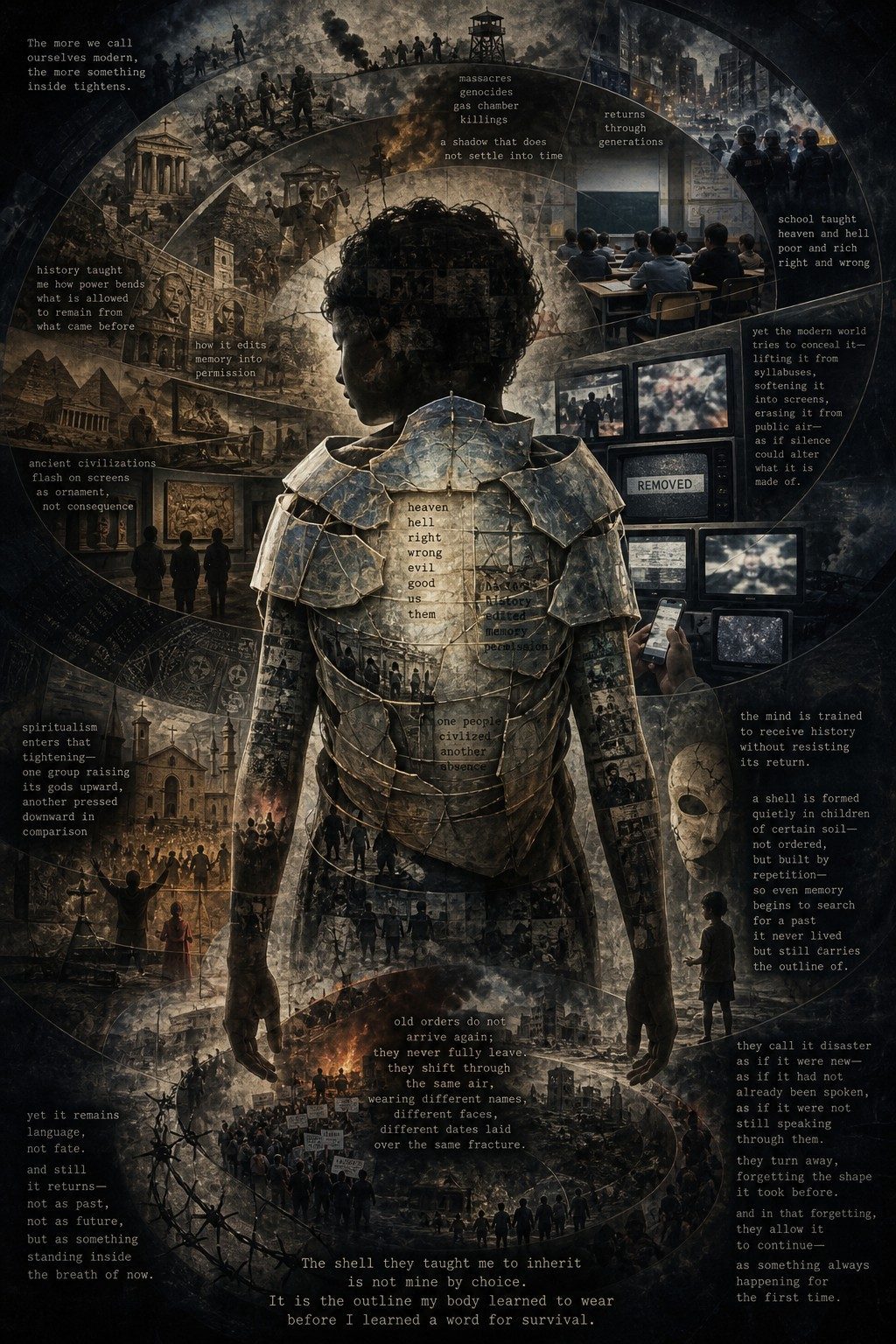
School taught heaven and hell,
poor and rich,
right and wrong,
evil and good—
as if the world were carved from edges
I was expected not to cross.
Assault from family, bullying from friends,
discrimination from society—
the world drew its lines through me
before I learned how to answer.
History taught how power bends
what is allowed to remain from what came before,
how it edits memory into permission,
how it teaches one group to see another
as less than human
without ever needing the word.
Massacres, genocides, gas chamber killings—
a shadow that does not settle into time,
a history that changes clothing but not motion,
returning through generations
as if it never left.
Yet the modern world tries to conceal it—
lifting it from syllabuses,
softening it into screens,
erasing it from public air—
as if silence could alter what it is made of.
The more we call ourselves modern,
the more something inside tightens.
Spiritualism enters that tightening—
one group raising its gods upward,
another pressed downward in comparison,
one people called civilized,
another written as absence.
Ancient civilizations flash on screens
as ornament, not consequence,
as pride without weight—
not warning, only display,
history framed to be admired
without touching.
The mind is trained to receive history
without resisting its return.
A shell is formed quietly in children of certain soil—
not ordered,
but built by repetition—
so even memory begins to search
for a past it never lived
but still carries the outline of.
Yet it remains language, not fate.
And still it returns—
not as past, not as future,
but as something standing inside the breath of now.
Old orders do not arrive again;
they never fully leave.
They shift through the same air,
wearing different names,
different faces,
different dates laid over the same fracture.
Those who once imagined them elsewhere
do not recognize their reflection when it returns.
They call it disaster as if it were new—
as if it had not already been spoken,
as if it were not still speaking through them.
They turn away,
forgetting the shape it took before.
And in that forgetting,
they allow it to continue—
as something always happening
for the first time.
The shell they taught me to inherit
is not mine by choice.
It is the outline
my body learned to wear
before I learned a word
for survival.
The poem feels like a slow, accumulating pressure of recognition—moving from personal vulnerability into systemic scale, where history, violence, and repetition are revealed not as separate events but as a continuous structure that reappears through changing forms and names. There’s grief in it, but not resolution; more an awareness that what persists is not only harm itself, but the systems that continually reorganize it so it appears unfamiliar each time. Alongside this runs a tense clarity, where naming becomes an act of resistance against both forgetting and the mechanisms that make recurrence seem like novelty.