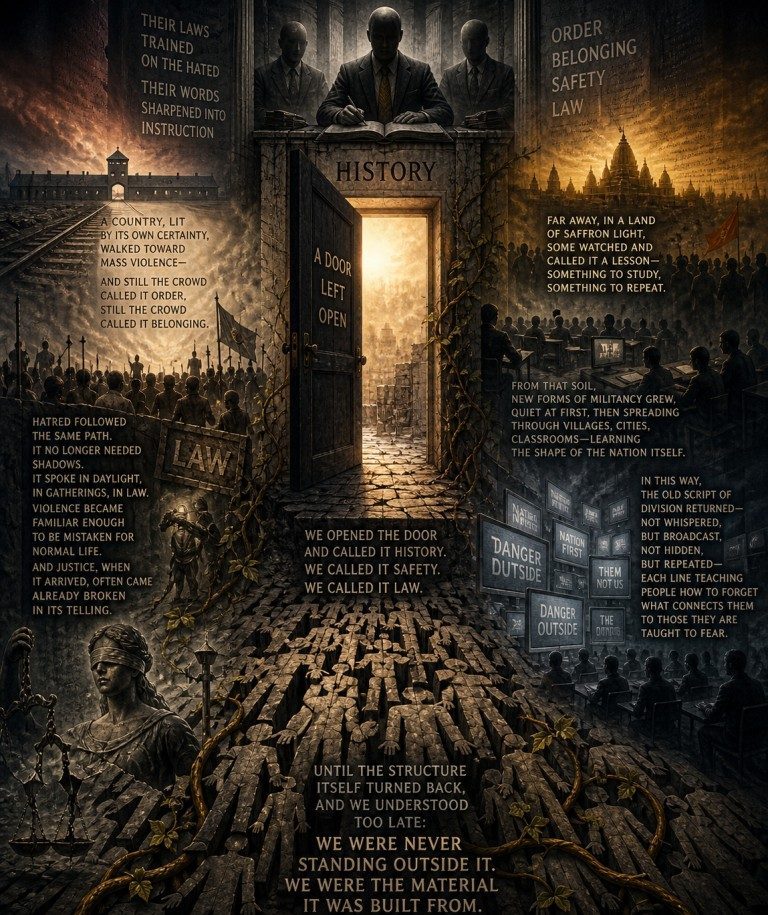
I read history as a door left open,
and found it guarded by a few—
their laws trained on the hated,
their words sharpened into instruction.
A country, lit by its own certainty,
walked toward mass violence—
and still called it order,
still called it belonging.
Far away, in a land of saffron light,
some watched and called it a lesson—
something to study, something to repeat.
From that soil, new forms of militancy grew:
quiet at first, then spreading
through villages, cities, classrooms—
learning the shape of the nation itself.
Hatred followed the same path.
It no longer needed shadows.
It spoke in daylight, in gatherings, in law.
Violence became familiar enough
to be mistaken for normal life,
and justice, when it arrived,
often came already broken in its telling.
In this way, the old script of division returned—
not whispered, but broadcast,
not hidden, but repeated—
each line teaching people
how to forget what connects them
to those they are taught to fear.
We opened the door and called it history.
We called it safety.
We called it law.
Until the structure itself turned back,
and we understood too late:
we were never standing outside it.
We were the material it was built from.