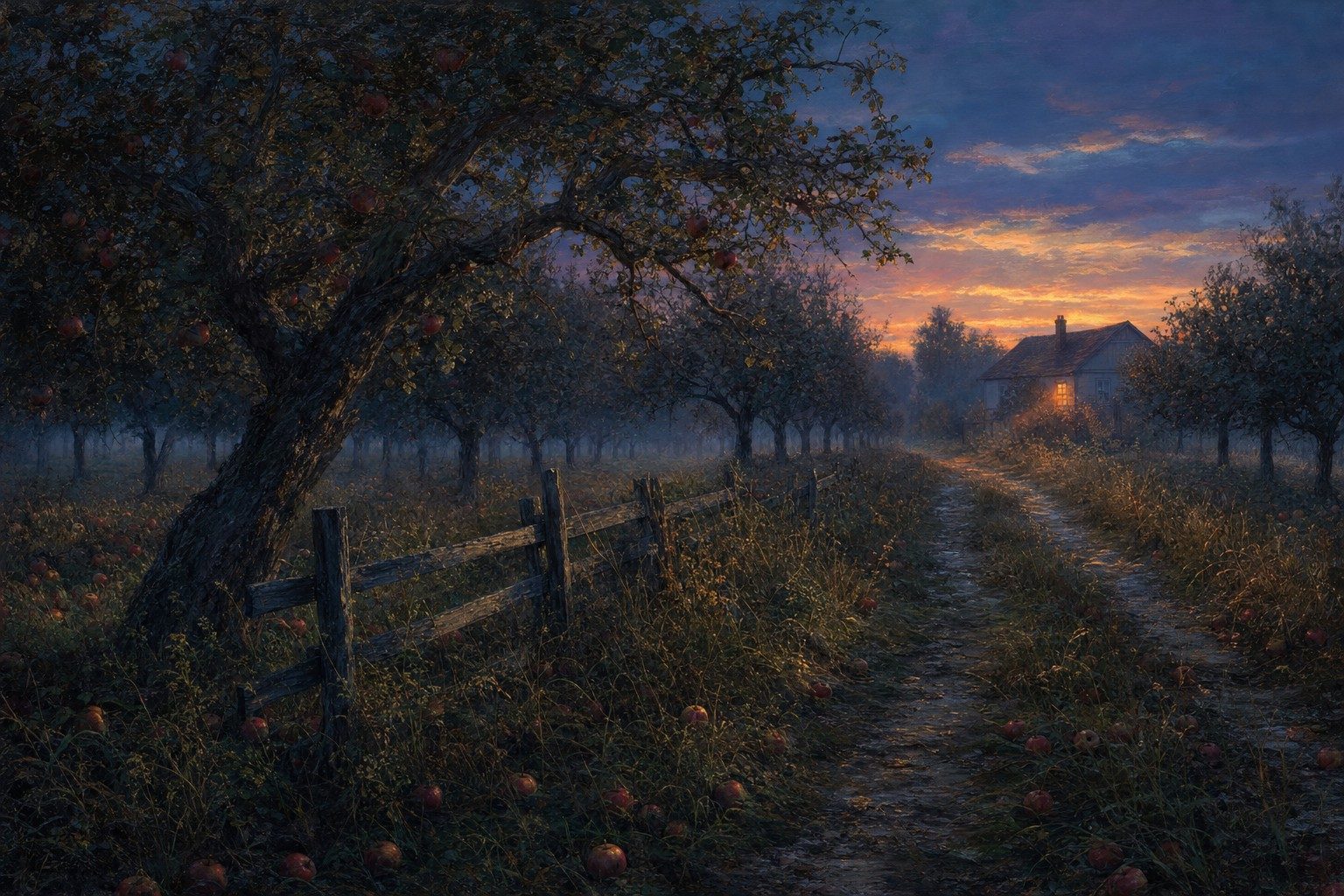
The Orchard of Almost

Speculative Poetry Human Written by Rewa Panta ·
Image for The Orchard of Almost

Somewhere behind my childhood home,
there is an orchard full of other lives.

In one, I say what I mean.
In another, I leave that summer
with nothing left unsaid.
Somewhere, a train waits
long enough for me to change my mind.

I visit when I cannot sleep.

The grass catches at my shoes.
Apples rot in the weeds.
I find the life where I was braver
and hate how easily she laughs.

I want to ask her what she knows
that I don't.
Instead, I watch her disappear
between the trees.

There are so many versions of me here.
Some have people I still miss.
Some have never met them.
I wonder which of us is luckier.

Near the fence, an old tree leans
over the path I used to take home.
I remember climbing it as a child,
scraping my knees,
hearing my mother call me in for dinner.

Back then, I never wondered
what my life might have been.
I was too busy living it.

The orchard grows dark.
Apples fall into the grass.
I don't know if the other lives are happy.
I never stay long enough to find out.

On the walk home,
I take the familiar road.

For once,
I don't wonder where else
it could have led.

How did this poem make you feel?

Share:

Community Score

10.0
out of 10

3 votes

Log in to vote on this poem.

Optional AI-generated literary feedback.

Poem Analysis

This analysis is provided as optional literary feedback. Community voting remains the primary ranking method.

Analysis Available

The poem explores the concept of alternate lives and choices through the metaphor of an orchard behind the speaker's childhood home. It is a contemplative piece that delves into themes of regret, nostalgia, and acceptance with a reflective tone. The artistic value lies in its evocative imagery and emotional depth.

Strengths

  • The metaphor of the orchard as a space of alternate lives is compelling and original (lines 1-2).
  • The imagery of 'apples rot in the weeds' effectively conveys decay and missed opportunities (line 8).
  • The poem's reflective tone is consistent and engaging, particularly in the lines about childhood innocence and the lack of questioning one's path (lines 24-26).

Areas for Improvement

  • The poem occasionally leans on familiar tropes, such as the notion of 'a train waits long enough for me to change my mind' (line 5), which can feel clichéd.
  • The structure lacks variation, which might limit the dynamic flow of the poem, as it primarily relies on free verse without much rhythmic experimentation.

Imagery

The poem uses vivid imagery to evoke a sense of place and emotion. The orchard is a powerful metaphor for the speaker's alternate lives, with 'apples rot in the weeds' symbolizing lost opportunities and decay. The image of 'a train waits' suggests moments of decision and the passage of time. The sensory detail of 'scraping my knees' and 'hearing my mother call me in for dinner' effectively transports the reader to the speaker's childhood, grounding the abstract concept in tangible experiences.

Structure

The poem is written in free verse, with a conversational tone that mirrors the introspective nature of the content. Line breaks are used to emphasize moments of reflection, such as 'I visit when I cannot sleep.' The lack of a formal rhyme scheme allows the poem to flow naturally, though this also results in a somewhat static rhythm. The stanza organization supports the narrative progression from contemplation to resolution.

Language & Craft

The diction is straightforward yet evocative, with a tone that balances nostalgia and introspection. The use of first-person voice creates intimacy, drawing the reader into the speaker's internal world. Alliteration is subtle, as seen in 'grass catches at my shoes,' enhancing the musicality of the language. The poem's language is accessible, which aids in its emotional resonance.

Emotional Impact

The poem's emotional impact is significant, as it taps into universal themes of regret, nostalgia, and the contemplation of alternate life paths. The speaker's longing and introspection are palpable, particularly in the lines about childhood and the uncertainty of other lives' happiness. The closing lines offer a poignant sense of acceptance, leaving the reader with a reflective, bittersweet feeling.

Generated by Openai (gpt-4o) on Oct 19, 2026 01:35

Comments

Log in to leave a comment.

No comments yet. Be the first to share your thoughts!

Related Poems in Speculative Poetry

Hell ,Earth , Heaven by Aditya Deshmukh · Sep 30, 2026
Unread by Aranee Saha · Aug 03, 2026
To Live Is To Learn by Christi Basilan · Jun 01, 2026
A nightwatcher of three names by Carmen Solares · Apr 28, 2026