Love is what I yearned for—
the kind where lovers wait an eternity
just to find each other.
The kind of love so strong
that neither gods nor demons
can tear it apart.
The kind before which
even death bows its head.
And I found a love like that.
Through the good and the bad,
it stayed with me,
refusing to leave.
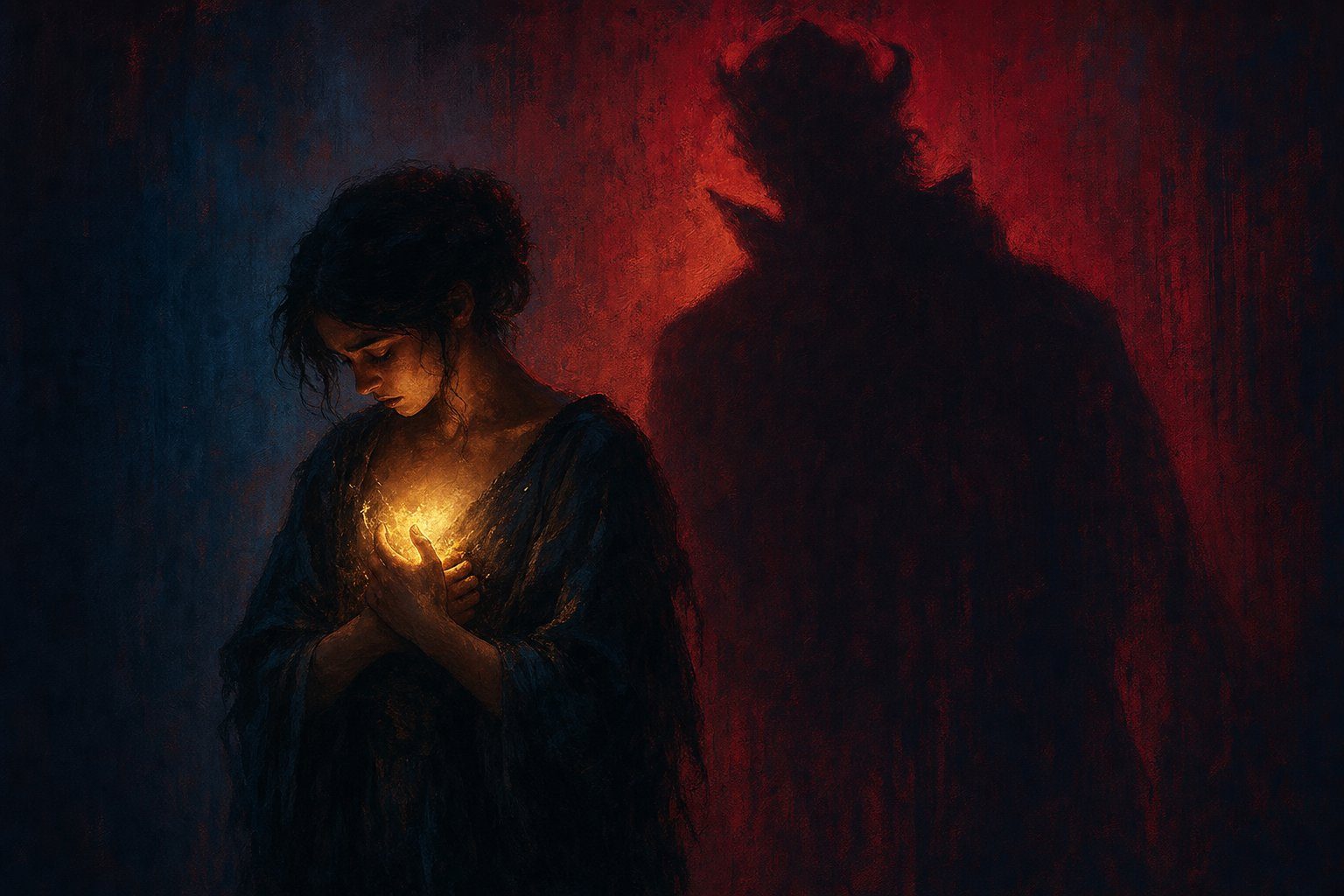
But every love story has a villain—
the one we hope dies in the movie,
the one we curse for standing in the way,
the one who keeps clinging
to someone
who was never meant to be theirs.
My story had one too.
It was me......
found it but at what cost
About This Poem
Textbook fairytale romance story unravels into harsh realities
How did this poem make you feel?
Community Score
4.5
out of 10
2 votes
Log in to vote on this poem.
Optional AI-generated literary feedback.
Analysis Available
Poem Analysis
This analysis is provided as optional literary feedback. Community voting remains the primary ranking method.
The poem explores the ideal of an eternal, unbreakable love, juxtaposed with the realization of self-sabotage as the true antagonist. It presents a compelling narrative with a twist, though it relies on familiar tropes and lacks innovative imagery.
Strengths
- The poem effectively uses a narrative twist, revealing the speaker as the villain in the love story ("My story had one too. It was me...").
- The poem builds tension by contrasting the idealized love with the presence of a 'villain' ("the one we hope dies in the movie").
- The theme of self-realization adds depth to the narrative, making the reader reconsider the nature of obstacles in love.
Areas for Improvement
- The imagery is conventional and lacks originality, relying on clichéd expressions like 'neither gods nor demons can tear it apart.'
- The poem's emotional impact is somewhat undercut by its predictable elements and lack of fresh metaphors.
Imagery
The poem employs traditional imagery associated with epic love, such as 'neither gods nor demons can tear it apart' and 'even death bows its head.' These images aim to elevate the love to mythic proportions but fail to introduce novel or vivid sensory details. The lack of specific, concrete imagery limits the poem's ability to create a memorable visual impact.
Structure
The poem is structured as a single stanza with a narrative arc, moving from the yearning for ideal love to the revelation of self as the antagonist. The free verse form allows for a conversational tone, but the absence of rhyme or meter may contribute to a lack of musicality. The line breaks emphasize key moments, such as the transition to the speaker's self-realization.
Language & Craft
The diction is straightforward, with a tone that shifts from romantic idealism to introspective self-criticism. The language is accessible, though it lacks linguistic flair or complexity. The use of repetition in 'the kind' emphasizes the speaker's longing for a specific type of love, but the poem could benefit from more varied and inventive language.
Emotional Impact
The poem's emotional resonance lies in its twist ending, which invites empathy and introspection. However, the emotional depth is somewhat limited by the reliance on familiar themes and expressions. While the narrative is engaging, the lack of novel emotional insights or vivid imagery may hinder its ability to profoundly move the reader.
Generated by Openai (gpt-4o) on Aug 13, 2026 10:49
Comments
Log in to leave a comment.
No comments yet. Be the first to share your thoughts!